Feedback On Starting An Adult ADHD Peer Support Group
We asked our clients for feedback on starting a free to access adult ADHD peer support group at the practice. The survey received 79 submissions. See the results below.
The group will be starting in the coming month – details to follow.
ADHD Support Group Survey Summary
Q1. Did you receive a diagnosis of ADHD at The Edinburgh Practice?
- Yes (80% of responses)
- No (20% of responses)
- Rather not say (0% of responses)
Total responses: 83
Q2. Are you receiving ADHD medication at the practice?
- Yes (85% of responses)
- No (13% of responses)
- Rather not say (2% of responses)
Total responses: 82
Skipped: 1
Q3. Would you be interested in attending a free to access Adult ADHD peer support group at the practice?
- Yes (90% of responses)
- No (10% of responses)
Total Responses: 79
Skipped: 4
Q4. When would be most suitable for you to attend? Please tick all that apply
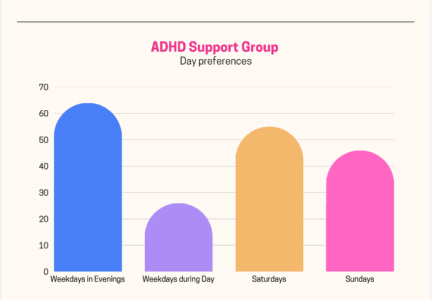
- Weekdays in Evenings (64% of responses)
- Weekdays during the Day (26% of responses)
- Saturdays (55% of responses)
- Sundays (45% of responses)
Total responses: 77
Skipped: 6
Evenings on weekdays were the most preferred option for the support group, selected by 64% of respondents, followed by Saturdays (55%) and Sundays (45%), while weekday daytime appointments were less popular (26%). These findings are based on 77 responses, with 6 participants not answering the question.
“Other” responses highlighted a preference for flexibility in scheduling, including requests for weekend evenings and morning sessions. Several respondents expressed interest in online or hybrid options due to location constraints or difficulty attending in person. There were also indications that varying session times may be beneficial, particularly to accommodate changing schedules.
A small number of respondents indicated that they would not wish to attend at all, while others noted potential barriers such as competing commitments. Suggestions were also made for alternative formats, including access to online resources or a virtual community. There were 10 “other” responses.
Q5. How often would you like the group to meet?
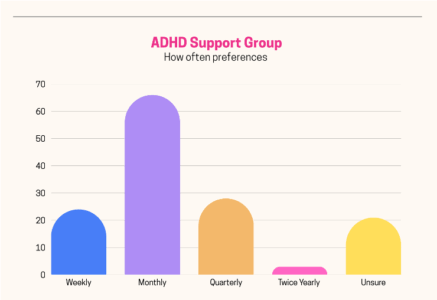
- Weekly (24% of responses)
- Monthly (66% of responses)
- Quarterly (28% of responses)
- Twice Yearly (3% of responses)
- Unsure (21% of responses)
Total responses: 76
Skipped: 7
Monthly sessions were the most preferred frequency, selected by 66% of respondents, followed by quarterly (28%) and weekly options (24%), while fewer respondents favoured twice-yearly sessions (3%); 21% of participants were unsure. These findings are based on 76 responses, with 7 participants not answering the question.
Responses provided under the “Other” option highlighted a preference for flexible scheduling. Several participants suggested alternatives such as fortnightly or bi-weekly sessions, as well as bi-monthly or every second month. Some noted that the ideal frequency may depend on the topic or level of involvement, with more frequent sessions suited to smaller or more focused discussions. Practical factors, such as travel distance, were also identified as influencing preferences. A small number of respondents indicated that they would not wish to attend. There were 8 “other” responses.
Q6. What would you like to see the support group offer? Please provide ideas or thoughts on what you think would be most helpful
Total Responses: 63
Skipped: 20
The most requested feature was the opportunity to share experiences and connect with others, mentioned by a clear majority of respondents (~ 40+ responses). Many participants highlighted the value of peer discussion, reducing isolation, and speaking with others who understand ADHD.
A second strong theme was the desire for practical strategies and coping tools for managing ADHD, also raised by a large proportion of respondents (~ 30 responses). This included support with time management, organisation, emotional regulation, motivation, and day-to-day functioning. Ways to create good habits and structured routines.
There was also notable interest in structured or themed sessions (~ 15–20 responses), with suggestions such as topic-focused discussions (e.g. work, relationships, sleep, finances) and a balance between guided content and open conversation. Interest also in emotion dysregulation, neurodiversity, and late diagnosis.
A smaller but recurring theme (~ 10–15 responses) was the inclusion of professional input or ADHD coaching, such as expert-led discussions, advice, or psychoeducation.
Several respondents (~ 8–10) highlighted the importance of flexibility and accessibility, including online options, smaller groups, or clear structure to support engagement.
Other less frequent suggestions included:
- Support around specific experiences, such as late diagnosis or parenting (~ 5–7 responses)
- Community-building and social activities (e.g. informal meetups, activities) (~ 5–8 responses)
- Resources and ongoing support, such as online platforms or resource hubs (~4–6 responses)
- Identity-specific or tailored groups (e.g. gender or work-based groups) (1–2 responses)
A small number of respondents (2–3) indicated that they would not wish to attend a support group.
Q7. Do you have any other comments or feedback?
Total Responses: 29
Skipped: 54
Overall, feedback was highly positive, with many responses expressing enthusiasm for the proposed support group and describing it as a valuable or much-needed initiative (approximately 12–15 responses). Several participants indicated they would be interested in attending and appreciated the opportunity to contribute feedback. Various commented that it was a great idea and are looking forward to it being set up.
The importance of peer connection and shared understanding was also highlighted, with respondents highlighting the benefit of meeting others with similar experiences and reducing feelings of isolation (~ 5–7 responses).
Some participants emphasised the need for flexibility and accessibility, particularly suggesting a combination of in-person and online options (~ 3–4 responses).
There were also considerations around group structure and facilitation, including the need for practical, solution-focused discussions rather than solely sharing difficulties, as well as managing common ADHD-related challenges such as distraction or interruption (~ 3–4 responses).
A small number of respondents raised potential barriers to engagement, such as social anxiety or lack of interest in attending, while others highlighted the importance of inclusivity (e.g. for AuDHD individuals) and maintaining confidentiality.
Several responses contained no additional comments.